

Back exercises with dumbbells are crucial for developing a powerful, pain-free posterior chain that supports all of your movements. Dumbbells offer unmatched versatility, whether your goal is to achieve that desired V-taper physique or just get rid of persistent back pain.
Dumbbells let your body move freely while requiring your stabilizer muscles to contract, in contrast to machines that limit your natural movement patterns.
Why Your Back Deserves Special Attention
Almost every physical activity you engage in during the day starts with your back. Your back muscles are constantly used to support your spine and maintain good posture, whether you’re sitting at your desk or lifting groceries.
The rounded-shoulder appearance that is so prevalent in today’s desk-bound society is caused by muscular imbalances brought on by neglecting back training. You’re investing in long-term health and functionality when you strengthen your back with focused dumbbell exercises.
The latissimus dorsi, rhomboids, trapezius, and erector spinae are just a few of the muscle groups that make up the back. For each of these muscles to fully develop, certain exercises are necessary, which is where dumbbells’ versatility comes into play.
You perform better in almost every other exercise when your back muscles are strong. Your pulling strength protects your spine during daily activities and has a direct impact on your capacity to lift larger weights in compound movements.
Understanding Back Anatomy for Better Training
Knowing the anatomy enables you to target each muscle group efficiently before beginning particular back exercises with dumbbells. The big, wing-like muscles that give your back its width are called latissimus dorsi, or lats.
Your scapula is retracted by your rhomboids, which are located between your shoulder blades. The trapezius, which extends from your neck to your mid-back, aids in the rotation and elevation of your shoulders.
The erector spinae muscles, which run the length of your spine, are essential for keeping your posture straight and avoiding lower back pain. You can choose exercises that specifically target your weak points by being aware of these muscle groups.
Essential Dumbbell Back Exercises for Beginners
You don’t need heavy weights or complex movements to begin your back training journey. These beginner-friendly dumbbell back exercises teach correct form and muscle activation while laying a strong foundation.
1. Dumbbell Bent-Over Row
This basic exercise develops functional pulling strength while targeting your entire back. The foundation of any successful back training regimen is the bent-over row.
How to perform:
- Stand with feet hip-width apart, holding a dumbbell in each hand
- Hinge forward at the hips until your torso is at a 45-degree angle
- Let the dumbbells hang straight down with your arms fully extended
- Keep your core tight and spine neutral throughout the movement
- Pull both dumbbells toward your lower ribcage, driving your elbows back
- Squeeze your shoulder blades together at the top of the movement
- Lower the weights with control back to the starting position
- Perform 3-4 sets of 10-12 repetitions
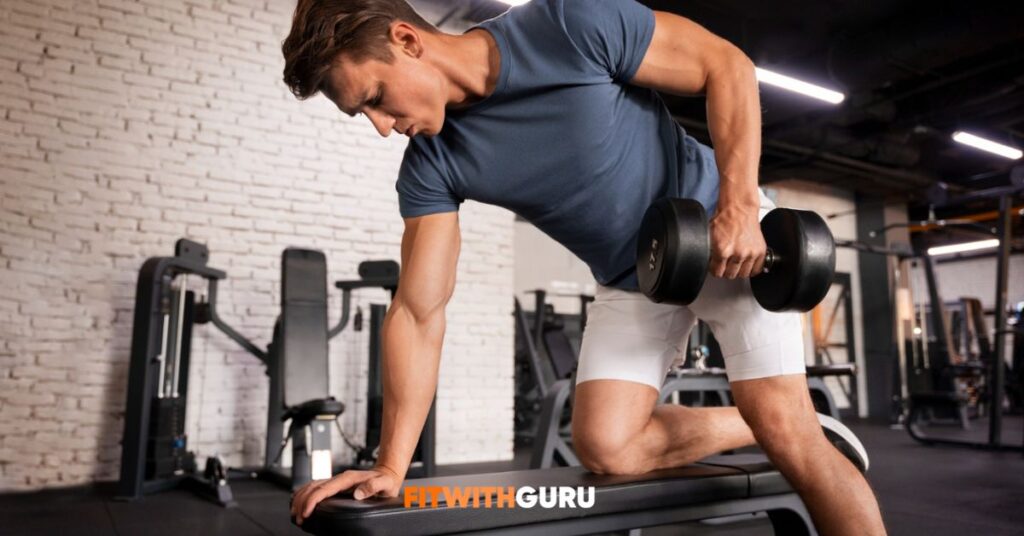
2. Single-Arm Dumbbell Row
You can concentrate on one side at a time while eliminating strength imbalances with this unilateral exercise. For novices, the single-arm version also offers superior lower back support.
How to perform:
- Place your left hand and left knee on a flat bench for support
- Keep your right foot planted firmly on the ground
- Hold a dumbbell in your right hand with your arm fully extended
- Pull the dumbbell straight up toward your hip, not your chest
- Keep your elbow close to your body throughout the movement
- Focus on pulling with your back muscles, not your biceps
- Lower the weight slowly and with control
- Complete 3 sets of 12-15 repetitions per side
3. Dumbbell Deadlift
The deadlift is mainly a posterior chain exercise, but it also works your erector spinae and lower back. This exercise teaches the important hip-hinge pattern and strengthens the entire back.
How to perform:
- Stand with feet hip-width apart, dumbbells resting on the ground outside your feet
- Bend at the hips and knees to grasp the dumbbells with a neutral grip
- Keep your chest up, shoulders back, and spine neutral
- Drive through your heels to stand up, extending your hips and knees simultaneously
- Keep the dumbbells close to your body throughout the lift
- Squeeze your glutes at the top position
- Lower the dumbbells back to the ground with control
- Perform 3-4 sets of 8-10 repetitions
Advanced Back Exercises with Dumbbells and Bench
Using a bench opens up more exercise options once you’ve mastered the fundamentals. For optimal muscle growth, these back exercises with dumbbells and a bench offer fresh perspectives and improved stability.
4. Incline Dumbbell Row
The incline angle increases upper back activation while decreasing lower back strain. For people who want to highlight their upper back development or who have lower back sensitivity, this variation is ideal.
How to perform:
- Set an adjustable bench to a 30-45 degree incline
- Face down on the bench with your chest against the pad
- Let the dumbbells hang straight down with arms fully extended
- Pull both dumbbells toward your lower chest
- Focus on squeezing your shoulder blades together
- Hold the contracted position for one second
- Lower the weights slowly back to the starting position
- Complete 3 sets of 10-12 repetitions
5. Chest-Supported Single-Arm Row
You can safely lift heavier weights with this exercise’s maximum stability. Your back muscles must do all the work because the chest support removes momentum.
How to perform:
- Set an adjustable bench to a 30-45 degree incline
- Face down with your chest on the bench
- Hold a dumbbell in one hand with your arm extended
- Row the dumbbell toward your hip while keeping your torso stable
- Rotate your wrist slightly at the top for maximum contraction
- Lower the weight with a 3-second eccentric phase
- Perform 3 sets of 10-12 repetitions per arm
6. Seal Row
This movement, which gets its name from the position that looks like a seal on a rock, gets rid of cheating. It is literally impossible to use momentum when correctly executing seal rows.
How to perform:
- Elevate a flat bench on blocks or plates so dumbbells can hang below
- Face down on the bench with your entire body supported
- Grasp dumbbells with a neutral grip, arms hanging straight down
- Pull both dumbbells toward your lower chest
- Keep your body completely still throughout the movement
- Squeeze hard at the top position
- Lower with control and repeat for 3 sets of 12-15 repetitions
Upper Back Exercises with Dumbbells for Posture
Your upper back suffers greatly from the constant forward-leaning positions of modern life. These back exercises with dumbbells for the upper back target the muscles that pull your shoulders back and keep your posture straight.
7. Dumbbell Reverse Fly
Your rear deltoids and rhomboids are the focus of this isolation exercise. Frequent reverse flies significantly enhance posture and shoulder health.
How to perform:
- Stand with feet shoulder-width apart, holding light dumbbells
- Hinge forward at the hips until your torso is nearly parallel to the ground
- Let the dumbbells hang straight down with a slight bend in your elbows
- Raise both dumbbells out to the sides in an arc motion
- Focus on squeezing your shoulder blades together
- Keep your core engaged to protect your lower back
- Lower the weights slowly back to the starting position
- Complete 3 sets of 15-20 repetitions
8. Dumbbell Shrug
Shrug both butts in the upper while focusing on your trapezius muscles to create a powerful look. When done correctly, this straightforward movement produces amazing results.
How to perform:
- Stand upright, right holding dumbbells at your sides with arms straight
- Keep your chest up and shoulders back
- Elevate your shoulders straight up toward your ears
- Hold the top position for 2 seconds, squeezing your traps
- Lower your shoulders back down with control
- Avoid rolling your shoulders forward or backward
- Perform 4 sets of 12-15 repetitions
Building Back Width with Dumbbell Exercises
Back exercises with dumbbells that focus on your lats are necessary to achieve that amazing V-taper. Exercises involving pulling motions at different angles lead to the development of width.
9. Dumbbell Pullover
Your lats are stretched and contracted throughout their entire range of motion with this unusual exercise. Your serratus anterior and chest muscles are also partially engaged by the pullover.
How to perform:
- Lie perpendicular across a flat bench with only your upper back supported
- Hold one dumbbell with both hands directly above your chest
- Keep a slight bend in your elbows throughout the movement
- Lower the dumbbell behind your head in a controlled arc
- Feel the stretch in your lats as the weight goes back
- Pull the dumbbell back to the starting position using your back muscles
- Complete 3 sets of 12-15 repetitions
10. Wide-Grip Dumbbell Row
You can highlight different parts of your back by varying the width of your grip. Tension is transferred to your rear deltoids and upper lats with a broader grip.
How to perform:
- Assume the standard bent-over row position
- Position your hands wider than shoulder-width on the dumbbells
- Pull the weights toward your upper chest rather than your lower ribs
- Keep your elbows flared out at about 45 degrees
- Squeeze your shoulder blades together at the top
- Lower with control and maintain constant tension
- Perform 3 sets of 10-12 repetitions
Creating an Effective Back Workout Routine
All back muscle groups develop in a balanced manner thanks to strategic programming. Exercises that target lower back strength, thickness, and width are part of a well-organized regimen.
Beginner Back Workout (2x per week):
- Dumbbell Deadlift: 3 sets x 8-10 reps
- Single-Arm Dumbbell Row: 3 sets x 12 reps per side
- Dumbbell Reverse Fly: 3 sets x 15 reps
- Dumbbell Shrug: 3 sets x 12 reps
Intermediate Back Workout (2x per week):
- Bent-Over Dumbbell Row: 4 sets x 10 reps
- Incline Dumbbell Row: 3 sets x 12 reps
- Dumbbell Pullover: 3 sets x 15 reps
- Single-Arm Row: 3 sets x 12 reps per side
- Dumbbell Shrug: 4 sets x 15 reps
Advanced Back Workout (2-3x per week with split):
- Dumbbell Deadlift: 4 sets x 6-8 reps
- Seal Row: 4 sets x 12 reps
- Single-Arm Row: 4 sets x 10 reps per side
- Reverse Fly: 4 sets x 15 reps
- Dumbbell Pullover: 3 sets x 12 reps
- Heavy Dumbbell Shrug: 4 sets x 10 reps
Common Mistakes to Avoid During Back Training
Even seasoned lifters make mistakes that hinder their back growth and raise their risk of injury. You can maximize results while training safely if you are aware of these mistakes.
Using momentum rather than deliberate muscle contractions is the most frequent mistake. Swinging weights is counterproductive and causes your back muscles to become less tense.
Another frequent mistake involves pulling with your arms rather than initiating the movement with your back. Think about pulling your elbows back rather than curling the weight up with your biceps.
Rounding your lower back during bent-over movements compresses your spinal discs and risks serious injury. By using your core and keeping your chest raised, you can always maintain a neutral spine.
Optimal muscle activation is prevented when the mind-muscle connection is neglected. Instead of merely transferring weight from point A to point B, visualize your back muscles contracting with each repetition.
Progressive Overload Strategies for Back Development
You must progress your training variables in a methodical manner in order to achieve continuous improvement. Simply performing the same workout with the same weights week after week leads to stagnation.
The most straightforward progression method is adding weight to the bench press so that you can complete all prescribed sets and reps. If you’re supposed to do 3 sets of 10 reps and you achieve this, increase the weight by 5 pounds next session.
Increasing volume by adding sets provides another effective progression strategy. If you are performing an exercise in three sets, increase to four sets while keeping the same weight and range of repetitions.
Without the need for larger weights, tempo manipulation tests your muscles in novel ways. To extend your time under tension, try lowering your rows for four seconds.
Your workout’s metabolic demand rises when you cut down on rest periods. Reduce your rest intervals from 90 seconds to 60 seconds over a period of several weeks.
FAQs
How often should I perform back exercises with dumbbells each week?
For the best development and recuperation, train your back two to three times a week. Beginners should begin with two sessions per week, giving themselves two to three days to recuperate.
Expert lifters can use a variety of exercise variations and intensities to train back three times a week. Large muscle groups in your back need enough time to recover in order to become stronger.
Can I build a complete back using only dumbbells without barbells or machines?
Absolutely! Dumbbells provide everything necessary for complete back development. Dumbbell-only training phases are used by many professional bodybuilders with great outcomes.
Choosing exercises that work the lats, rhomboids, traps, and erector spinae—all of the back muscle groups—is crucial. In fact, dumbbells have some advantages over barbells, such as less strain on the lower back and independent arm movement.
What weight dumbbells should I use for back exercises as a beginner?
Start with weights that will challenge you on the final two to three repetitions while enabling you to perform 10–12 repetitions with correct form. For rowing exercises, most novices use dumbbells weighing 15–25 pounds, and for isolation exercises like reverse flies, they use dumbbells weighing 10–15 pounds.
You shouldn’t expect to use the same weight for reverse flies and deadlifts because your strength will differ greatly between exercises. Prior to increasing the weight, concentrate on perfect form because high-quality repetitions develop muscle more quickly than heavy, careless ones.
Why do I feel back exercises with dumbbells more in my arms than my back?
Starting pulls with your biceps rather than your back muscles is the cause of this frequent issue. Instead of curling your hands toward your body, concentrate on pulling your elbows back. Imagining your hands as hooks that merely support the weight while your back pulls is another useful cue.
Improving the mind-muscle connection can also be achieved by pre-exhausting your back with lighter isolation exercises prior to compound movements.
Are back exercises with dumbbells and a bench better than standing variations?
Both have distinct advantages depending on your goals and limitations. Bench-supported exercises eliminate lower back fatigue, allowing you to focus entirely on your upper and mid-back muscles. Standing variations engage your core and lower back stabilizers more, building functional strength.
The best method combines both approaches: stand exercises for general back development and bench variations that target the upper legs.
Conclusion
Back exercises with dumbbells offer a comprehensive approach to developing a robust, muscular, and functional posterior chain. You can efficiently target every back muscle from the comfort of your home or any gym thanks to the versatility of dumbbell training.
Steady progress is ensured by beginning with basic motions like bent-over rows and gradually moving on to more intricate variations. Dumbbells are effective whether your objective is to improve athletic performance, get rid of back pain, or create an amazing V-taper.
Building a strong body, in our opinion at FitWithGuru.com, improves not just your physical appearance but also your general quality of life. Strong back muscles help you perform better in all physical activities, improve your posture, and lessen pain.
Keep in mind that lifting large weights is never more important than using proper form. Before moving on to heavier weights, master the movement patterns with smaller loads.
