

Full body calisthenics exercises represent the ultimate solution for building serious strength and muscle without stepping foot in a gym.
These powerful bodyweight movements prove that you don’t need expensive equipment to achieve remarkable fitness results—just your body, determination, and the right training approach.
What Are Full Body Calisthenics Exercises?
Full body calisthenics exercises are compound movements that engage multiple muscle groups simultaneously using only your bodyweight as resistance.
Unlike isolation exercises that target individual muscles, these movements create functional strength patterns that mirror how your body naturally moves in daily life.
The term “calisthenics” originates from the Greek words “kalos” meaning beauty and “sthenos” meaning strength, literally translating to “beautiful strength.”
The Science Behind Bodyweight Training
Your muscles don’t differentiate between dumbbells and bodyweight resistance—they only recognize tension, time under tension, and progressive mechanical overload.
When you perform a push-up correctly, your muscles contract against approximately 60-70% of your total bodyweight, creating significant stimulus for strength and muscle growth.
Full body calisthenics workouts activate stabilizer muscles that machines completely neglect, creating balanced strength development throughout your entire kinetic chain.
Research demonstrates that compound calisthenics movements produce similar hypertrophy and strength gains compared to traditional weightlifting when programmed with proper progressive overload.
Powerful Benefits of Full Body Calisthenics Workouts
The advantages of embracing full body calisthenics exercises no equipment extend far beyond simple convenience and accessibility.
Ultimate Cost-Effective Fitness: You’ll never waste money on expensive gym memberships or thousands of dollars in equipment.
Functional Strength Development: Every movement pattern you master translates to improved performance in daily activities and sports.
Superior Body Awareness: Calisthenics demands exceptional kinesthetic awareness, fostering a mind-muscle connection superior to that of machine-based training.
Infinitely Scalable for All Levels: Complete beginners can start with simple variations while advanced athletes progress to muscle-ups and handstand push-ups.
Enhanced Mobility and Flexibility: Dynamic movements through complete ranges of motion improve joint health and tissue elasticity.
Dramatically Reduced Injury Risk: Learning to control your bodyweight creates natural movement patterns that protect joints and connective tissue.
Cardiovascular Conditioning: Circuit-style calisthenics training elevates heart rate while simultaneously building muscular strength.
Train Anywhere, Anytime: Parks, hotel rooms, your living room—the entire world becomes your personal training facility.
Time Efficiency That Fits Any Lifestyle
Full body calisthenics exercises allow you to complete comprehensive workouts in just 30-45 minutes without wasting time commuting to crowded gyms.
Busy professionals can train during lunch breaks, parents can exercise while kids play, and travelers can maintain fitness anywhere their adventures take them.
Essential Full Body Calisthenics Exercises List
Let me walk you through the fundamental movements that underpin any comprehensive calisthenics program.
Push-Ups: The Ultimate Upper Body Foundation
Push-ups remain the undisputed king of upper-body calisthenics, engaging your chest, shoulders, triceps, and core when performed correctly.
How to Perform Perfect Push-Ups:
- Start in a high plank position with hands slightly wider than shoulder-width apart.
- Keep your entire body in a straight line from head to heels. Lower your chest toward the ground by bending your elbows to 45 degrees.
- Maintain constant core tension and squeeze glutes throughout the movement.
- Push back up to the starting position explosively while maintaining body alignment. Exhale forcefully on the push, inhale deeply on the descent.
Variations include wide-grip, diamond, archer, and decline push-ups to target different muscle emphases and difficulty levels.
Pull-Ups: Building a Powerful V-Shaped Back
Pull-ups develop your lats, biceps, rear delts, and grip strength while creating that coveted V-taper physique.
How to Perform Pull-Ups:
- Hang from a bar with hands shoulder-width apart, palms facing away. Engage your core muscles and squeeze your shoulder blades together.
- Pull yourself upward by driving your elbows down and back toward your hips. Aim to bring your chin clearly above the bar height.
- Lower yourself with complete control to full arm extension. Avoid swinging or using momentum to complete repetitions.
If you can’t perform a full pull-up yet, start with negative pull-ups or use resistance bands for assistance.
Squats: Lower Body Power Development
Bodyweight squats build leg strength, improve hip and ankle mobility, and create a foundation for explosive athleticism in any sport.
How to Perform Bodyweight Squats:
- Stand with feet hip to shoulder-width apart, toes slightly outward. Keep chest up, shoulders back, and core engaged throughout.
- Lower by simultaneously pushing hips back and bending knees. Descend until thighs are parallel to ground or lower if mobility allows.
- Drive through heels and midfoot to return to standing position. Keep knees tracking over toes, never allowing them to cave inward
Progress to pistol squats (single-leg squats) for an advanced challenge that dramatically increases difficulty.
Dips: Triceps and Lower Chest Developer
Dips can be performed on parallel bars, sturdy chairs, or any stable elevated surface for powerful upper body pressing development.
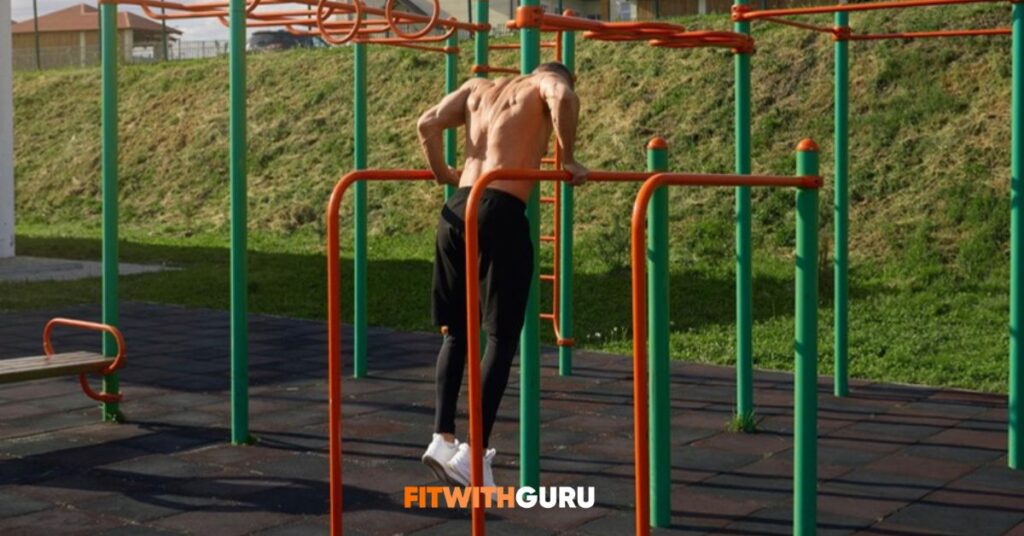
How to Perform Dips:
- Support yourself on parallel bars with arms fully extended. Lean slightly forward for chest emphasis or stay upright for triceps focus.
- Lower your body by bending elbows to approximately 90 degrees. Keep shoulders down and back, away from ears throughout movement.
- Press back up to starting position with controlled force. Maintain core engagement to prevent swinging
Plank Variations: Bulletproof Core Stability
Planks and their variations create exceptional core strength essential for all athletic movements and injury prevention.
How to Perform Planks:
- Assume forearm or high plank position with elbows under shoulders. Create a perfectly straight line from head through heels.
- Engage every muscle—quadriceps, glutes, core, shoulders simultaneously. Hold for prescribed time while breathing steadily
- Avoid sagging hips or piking at the waist. Squeeze glutes hard to protect lower back
Try side planks, plank shoulder taps, and plank-to-push-up transitions for comprehensive core development.
Burpees: Full Body Metabolic Conditioning
Burpees combine strength training and cardiovascular conditioning into one incredibly effective full body exercise.
How to Perform Burpees:
- Start standing tall with feet hip-width apart.Drop down into squat position with hands planted on floor.
- Kick feet back explosively into high plank position. Perform one quality push-up (optional for beginners).
- Jump feet back forward toward hands quickly. Explosively jump upward with arms reaching overhead
This exercise appears in virtually every full body calisthenics exercises list because it delivers unmatched metabolic conditioning.
Lunges: Unilateral Leg Strength and Balance
Lunges address muscle imbalances between legs while building functional single-leg strength and stability.
How to Perform Lunges:
- Stand tall with feet hip-width apart. Step forward with one leg, landing heel first.
- Lower back knee toward ground while keeping front shin vertical. Both knees should form approximately 90-degree angles.
- Push through front heel to return to starting position • Keep torso upright and core engaged throughout
Walking lunges, reverse lunges, and jumping lunges provide excellent progressions and variations.
Mountain Climbers: Dynamic Core Training
Mountain climbers combine core stability with cardiovascular challenge in a compact, equipment-free movement.
How to Perform Mountain Climbers:
- Start in high plank position with shoulders over wrists. Bring one knee toward your chest while keeping hips level.
- Quickly switch legs in a continuous running motion. Maintain stable plank position throughout.
- Keep core tight and avoid rotating hips side to side. Breathe rhythmically with the movement pattern
Creating Effective Full Body Calisthenics Workouts
Programming full body calisthenics exercises no equipment requires understanding fundamental training principles that drive adaptation and results.
Workout Structure for Complete Beginners
Start with 3 training sessions per week, allowing at least one full rest day between sessions for adequate recovery.
Perform each exercise for 8-12 repetitions or 20-40 seconds for static holds, completing 2-3 complete rounds.
Rest 60-90 seconds between individual exercises and 2-3 minutes between complete circuit rounds.
Sample Beginner Routine:
| Exercise | Reps/Time | Sets | Rest |
| Push-Ups (Incline) | 8-10 | 3 | 60s |
| Bodyweight Squats | 12-15 | 3 | 60s |
| Plank Hold | 30 sec | 3 | 60s |
| Reverse Lunges | 10 each | 3 | 60s |
| Mountain Climbers | 20 sec | 3 | 60s |
Intermediate Progression Strategy
As you advance, increase the training frequency to 4-5 sessions per week while incorporating more challenging movement variations.
Implement progressive overload by increasing repetitions, slowing tempo, shortening rest intervals, or incorporating advanced movement patterns.
Sample Intermediate Routine:
| Exercise | Reps/Time | Sets | Rest |
| Standard Push-Ups | 15-20 | 4 | 45s |
| Jump Squats | 12-15 | 4 | 45s |
| Parallel Bar Dips | 10-12 | 4 | 45s |
| Walking Lunges | 12 each | 3 | 45s |
| Pull-Ups (Assisted) | 6-8 | 4 | 90s |
| Burpees | 10 | 3 | 60s |
Advanced Training Protocols
Advanced practitioners should explore skill-based movements like handstands, muscle-ups, front levers, and planche progressions.
Implement periodization cycles that alternate between strength, hypertrophy, and skill development phases.
Consider training 5-6 days weekly with strategic splits that allow adequate recovery for specific movement patterns.
Common Mistakes to Avoid
Even experienced athletes make critical errors that limit progress or increase injury risk with full body calisthenics workouts.
Sacrificing Form for Repetitions: Quality always trumps quantity—one perfect repetition builds more strength than five sloppy repetitions.
Neglecting Progressive Overload: Your body adapts rapidly, so you must continually increase difficulty through variations or volume.
Skipping Proper Warm-Up: Dynamic stretching and movement preparation prevents injuries and enhances workout performance by 15-20%.
Ignoring Recovery Requirements: Muscles grow during rest periods, not during workouts—prioritize quality sleep and proper nutrition.
Training Through Sharp Pain: Normal muscle discomfort differs completely from joint or tendon pain that signals potential injury.
Imbalanced Programming: Pushing movements should balance with pulling movements to prevent postural dysfunction and shoulder issues.
Nutrition Strategies for Calisthenics Success
Your dietary choices determine whether you’ll build muscle, lose body fat, or maintain your physique regardless of training volume.
Consume adequate protein (0.7-1 gram per pound of bodyweight daily) to support muscle recovery and growth.
Time carbohydrate intake strategically around workouts to fuel performance and replenish muscle glycogen stores.
Healthy fats support hormone production—aim for 20-30% of total daily calories from quality fat sources.
Stay consistently hydrated by drinking half your bodyweight in ounces daily, increasing during intense training sessions.
Tracking Progress Without Weights
Since full-body calisthenics exercises don’t involve external loads, you’ll need alternative progress markers. Record maximum repetitions achieved for each exercise weekly, aiming to add 1-2 quality reps each training cycle.
Track total time-to-completion for circuit workouts, working to reduce duration while maintaining perfect form. Video record your exercise form regularly to identify technical improvements and movement quality enhancements. Take weekly progress photos and monthly body measurements to document physique changes that mirrors won’t reveal.
Frequently Asked Questions
Can you build serious muscle with full body calisthenics exercises?
Absolutely—complete body calisthenics exercises can build significant muscle mass when programmed intelligently with progressive overload principles.
Your muscles respond to mechanical tension and metabolic stress regardless of whether resistance comes from barbells or controlled bodyweight movements.
Studies demonstrate that calisthenics practitioners can achieve hypertrophy comparable to traditional resistance training when exercises are performed to near-failure with appropriate volume.
The key is to progressively increase difficulty through advanced variations, slower tempos, or systematically increased volume as you adapt.
How often should I do full-body calisthenics workouts?
Beginners should train 3-4 times weekly, allowing adequate recovery between sessions for optimal adaptation.
Intermediate practitioners can safely increase the frequency to 4-5 sessions per week as work capacity improves and recovery efficiency improves.
Advanced athletes often train 5-6 days weekly, implementing strategic splits that distribute training stress across different movement patterns.
Listen to your body—persistent fatigue, declining performance, or joint discomfort signal inadequate recovery and may require additional rest days.
What is the best full-body calisthenics exercise list for beginners?
Start with fundamental movements: incline push-ups, bodyweight squats, forearm planks, reverse lunges, glute bridges, and dead hangs, if bar access is available.
These exercises establish proper movement patterns and baseline strength necessary for safely progressing to advanced variations.
Focus on mastering perfect form before increasing difficulty—quality movement patterns prevent injuries and accelerate long-term progress.
Begin with modified versions, such as wall push-ups, if standard variations are too challenging at your current fitness level.
Can full body calisthenics exercises no equipment, completely replace gym training?
Yes—intelligent bodyweight training provides everything necessary for building impressive strength, lean muscle, cardiovascular endurance, and functional mobility.
Elite calisthenics athletes demonstrate incredible physiques and strength levels rivaling traditional gym enthusiasts through progressive bodyweight training alone.
How long does it take to see noticeable results from full body calisthenics workouts?
Neurological adaptations occur within 2-3 weeks as your nervous system learns efficient movement patterns and improves motor unit recruitment.
Visible physical changes typically emerge after 6-8 weeks of consistent training, combined with proper nutrition that supports your goals.
Strength gains manifest progressively—expect to add repetitions or advance to more complex variations every 2-4 weeks with dedicated training.
Consistency determines results more than any other factor—sporadic training yields minimal progress regardless of program quality.
Conclusion
Full body calisthenics exercises deliver real results without requiring gym memberships or expensive equipment—just commitment and consistency.
Master the fundamental movements, progress systematically, and watch your strength and physique transform through disciplined bodyweight training.
